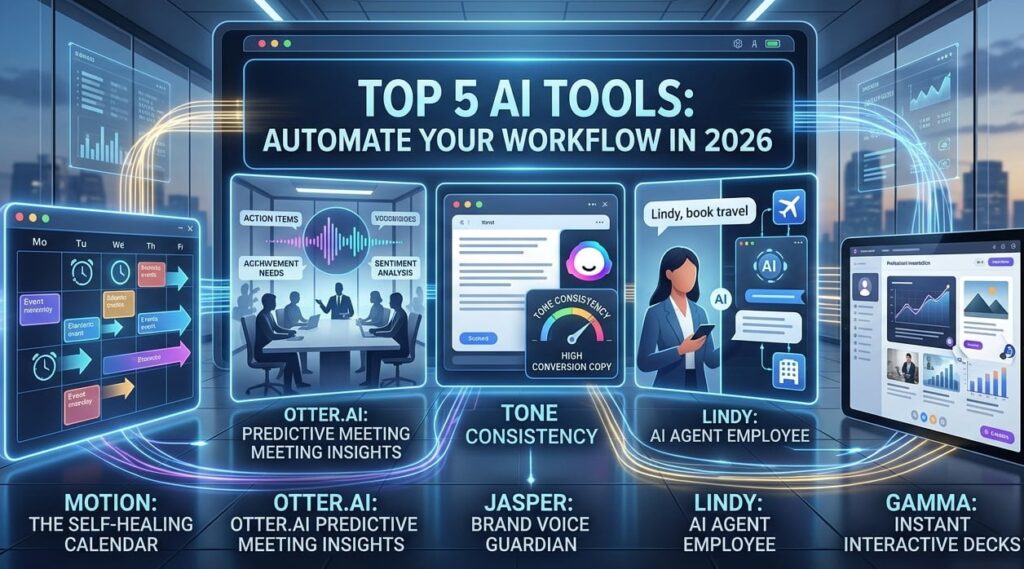
Top 5 AI Productivity Tools to Automate Your Workflow in 2026
If your daily routine still involves manual scheduling, basic data entry, or summarizing long meeting transcripts by hand, you are operating at a significant disadvantage. Here are the five essential AI tools that are currently redefining professional efficiency.
⏱️ 3 minutes
The digital landscape has shifted. In 2026, we are no longer in the era of «learning how to use AI»; we are in the era of AI orchestration. Productivity is no longer measured by how many emails you send, but by how effectively you manage the autonomous agents that do the work for you.
1. Motion: The Self-Healing Calendar
Traditional calendars are static; Motion is alive. Using a proprietary algorithm often referred to as «Happiness Engineering,» Motion doesn’t just store your appointments it builds your day.
How it works: When a meeting runs over or an urgent task appears, Motion automatically reshuffles your entire week. It prioritizes deep-work blocks based on your energy levels (which it learns over time) and ensures that deadlines are met without you ever touching a «drag and drop» button.
The ROI: Users report saving an average of 10 hours per week on administrative planning alone.
2. Otter.ai: From Transcription to Predictive Insights
Otter.ai has evolved far beyond simple voice-to-text. In 2026, its new «Predictive Insights» engine analyzes the sentiment and trajectory of your meetings.
The Edge: It doesn’t just tell you what was said; it identifies unspoken commitments. If a client mentions a «potential interest in a new feature,» Otter automatically drafts a follow-up proposal and moves it to your CRM. It acts as a silent Chief of Staff that attends every call with you.

3. Jasper: The Guardian of Brand Voice
As the internet becomes flooded with generic AI content, originality is the new gold. Jasper’s 2026 «Brand Identity» update allows companies to upload their entire history of successful campaigns, internal memos, and style guides.
Why it’s essential: Unlike basic LLMs that can sound robotic, Jasper generates high-converting copy that is indistinguishable from your top human copywriters. It ensures that whether you are writing a Tweet or a 50-page whitepaper, the tone remains perfectly aligned with your brand’s DNA.
4. Lindy: The First True AI Employee
Lindy isn’t just a chatbot; she is an AI Agent. While other tools help you do a task, Lindy is the task.
Capabilities: You can «hire» Lindy to handle your customer support, manage your recruitment filtering, or even coordinate your travel logistics. She can connect to over 3,000 different apps, meaning she can actually act on information like booking a flight or issuing a refund rather than just talking about it.
5. Gamma: Death to the Powerpoint
The days of spending six hours on a slide deck are officially over. Gamma uses generative AI to turn a simple prompt or a rough document into a stunning, interactive presentation.
The Innovation: Gamma creates «fluid decks» that look great on any device. It suggests layouts, pulls in relevant live data visualizations, and even writes the speaker notes for you. In a world where speed is a competitive advantage, Gamma allows you to go from «idea» to «pitch-ready» in under two minutes.
The Bottom Line for 2026
The goal of using these tools isn’t just to work faster; it’s to reclaim your cognitive load. By delegating repetitive logic and organization to AI, you free your brain to focus on what humans still do best: high-level strategy, creative empathy, and complex problem-solving.
As AdSense revenue often hinges on «Tech-Savvy» audiences, focusing on these high-end tools attracts a demographic with high purchasing power, exactly what premium advertisers are looking for.